Bedding Guide
Natural Latex Toppers: Choosing Thickness and Firmness for Your Sleep Setup
A latex topper can change the first impression of a mattress without rebuilding the support beneath it. The right choice depends on more than a label such as “soft” or “firm”: thickness, latex process, your sleep position, and the condition of the mattress all shape the result.
Published October 19, 2026
A mattress is a layered landscape. Beneath its fabric cover may sit springs, foam, latex, fiber padding, or some combination of materials. A topper adds another layer to that terrain, altering how the surface yields under shoulders, hips, and other pressure points. Natural latex is valued for its buoyant, responsive feel: it compresses under weight, then pushes back rather than slowly enveloping the sleeper.
That response can make a latex mattress topper useful when an otherwise supportive mattress feels too firm at the surface. But a topper is not a repair for every problem. It cannot restore a sagging support core, correct a broken foundation, or reliably transform a mattress whose basic dimensions and support are wrong for the sleeper. Choosing well begins with reading the bed you already have.
The central questions are practical: How much change is needed? How much space is available for added height? Does the mattress beneath still provide even support? And what does “comfortable” mean for the person sleeping there? The answers help narrow the choices in thickness and latex firmness without treating any single configuration as universal.
What a latex topper can—and cannot—change
A topper primarily affects the comfort layer: the upper portion of a sleep surface that cushions the body and influences initial feel. By adding latex, a sleeper may gain a more forgiving surface, a springier response, or a small measure of pressure relief. The degree of change depends on the topper’s thickness and firmness, along with the materials and condition beneath it.
It is helpful to distinguish surface comfort from underlying support. Comfort describes how the bed feels at first contact and how pressure is distributed across the body. Support refers to how the mattress holds the body in a reasonably stable position. The two interact, but they are not interchangeable. A soft topper may make a hard surface more welcoming; it will not make a deeply sagging mattress level again.
Before shopping, inspect the mattress in daylight. Look for visible dips, uneven edges, broken coils, damaged foam, or areas that feel substantially different from the rest of the bed. Check the foundation as well: a weak or unsuitable base can contribute to an uneven sleep surface. If the mattress has lost its shape, a topper may temporarily disguise the problem while leaving its cause untouched.
Also consider the mattress’s age and warranty guidance. Some manufacturers specify which foundations or added layers are appropriate, and a topper may affect the feel or performance expectations of a bed. When the mattress remains structurally sound but feels a little too firm, a topper is more likely to be a useful adjustment.
Thickness: how much change do you want?
Thickness is the vertical depth of the latex layer. It influences how far the sleeper can settle into the topper before encountering the firmer mattress below. A thinner topper tends to make a more restrained adjustment; a thicker one generally creates a more noticeable change. This is a tendency, not a guarantee: a firm, thick layer may feel quite different from a soft layer of the same depth.
A thinner layer
A relatively thin topper may gently soften the surface while allowing more of the mattress’s original feel to come through. It can suit someone seeking a subtle adjustment rather than a new sleep surface.
A middle thickness
A moderate layer can create a more distinct cushioning effect. It may be a practical place to begin when the mattress feels uniformly firm but remains supportive and level.
A thicker layer
A thicker topper can make a substantial difference to the surface feel, but it also adds height and may allow more body settlement. Compatibility with the mattress and the sleeper’s needs becomes especially important.
These descriptions are relative rather than fixed rules. Manufacturers may offer different thickness options, and latex density, firmness, and construction can vary. Compare specifications within the same product line when possible, rather than assuming that a certain number of inches behaves identically across all brands.
Added height also changes the practical details of a bed. Deep-pocket sheets may be needed, fitted sheets may pull loose, and the mattress may sit higher against a headboard or bed frame. If the bed already feels tall, a thick topper can make getting in and out less convenient. Check the depth of the mattress and the fitted-sheet pockets before choosing.
Thickness may also influence how much the sleeper notices the mattress underneath. A thin layer follows the character of the existing surface more closely. A thicker one can soften that impression, but it still rests on the mattress’s support structure. If the underlying bed has a pronounced depression, adding material above it does not necessarily create a flat, stable plane.
Firmness: a personal fit, not a universal scale
Firmness describes how a material feels under load, but ratings are not perfectly standardized across manufacturers. One company’s “medium” may differ from another’s, and the same topper can feel different to people with different body shapes, weights, and sleep habits. Treat firmness labels as useful clues, not precise measurements.
A softer latex topper generally compresses more readily at first contact. That can provide a more cushioned sensation, especially where the body presses more heavily into the bed. A firmer latex topper tends to resist compression sooner, preserving more of the mattress’s original firmness and creating a more lifted surface. Between these ends are medium options intended to balance give and pushback.
Firmness should be considered together with thickness. A soft, thin layer may produce a gentle change, while a soft, thick layer may feel substantially more yielding. Conversely, a firm topper can feel supportive but may not deliver much pressure relief to someone hoping to soften a very hard mattress. Neither firmness nor thickness can be evaluated fully in isolation.
For people sharing a bed, different comfort preferences can complicate the decision. A topper that covers the entire mattress may not satisfy both sleepers equally. Some latex mattresses use separate configurations on each side, but topper arrangements vary by size and construction. Check whether the product is offered in split options, and consider whether a seam in the middle would be acceptable.
Start with sleep position and pressure points
Sleep position offers a useful starting point because it changes which parts of the body meet the mattress most directly. It does not dictate a single ideal firmness, but it can help identify what kind of adjustment may be worth testing.
- Side sleeping: The shoulder and hip often carry more concentrated pressure. Someone who feels persistent firmness at these points may prefer a more cushioning surface, provided the bed continues to feel stable and comfortable overall.
- Back sleeping: A balanced surface may feel preferable—cushioning enough to avoid a hard contact sensation, yet supportive enough that the sleeper does not feel excessively sunk into the bed.
- Stomach sleeping: Some stomach sleepers prefer a firmer, more level feel. A very soft or thick topper may allow more settling, so a restrained adjustment may be worth considering.
- Combination sleeping: People who change positions may value a responsive surface that does not feel difficult to move across. Latex’s buoyant character can feel different from materials that respond more slowly, though the experience depends on the complete mattress system.
These are broad considerations, not medical directions. Body proportions, individual comfort, bedding, and the mattress beneath all influence the outcome. If discomfort is persistent, severe, or associated with a health condition, a topper choice is not a substitute for advice from a qualified health professional.
Pay attention to the pattern of discomfort rather than relying only on the word “firm.” Is the surface uncomfortable across the entire body, or mainly at the shoulders? Does the lower back feel unsupported, or does the sleeper feel pressure where the body meets the mattress? A topper can address some surface sensations, but distinct issues may point to a different cause.
Natural latex construction: Dunlop and Talalay
Natural latex begins with the milky sap of rubber trees, which is processed into a resilient foam. “Natural” describes a source, but the finished material is still manufactured. The two commonly discussed processes, Dunlop and Talalay, differ in how the latex is formed and processed. Their names can help describe construction, but they do not by themselves tell a shopper exactly how a topper will feel.
Dunlop latex is produced through a process in which the latex mixture is poured into a mold and then vulcanized. Talalay uses additional steps that include vacuum expansion and freezing before vulcanization. These methods can yield materials with different structures and feel characteristics, though firmness, formulation, and product design also matter. A shopper should compare the actual firmness descriptions and specifications rather than choosing solely by process name.
Some products combine latex with other materials or use a cover that changes the surface feel. Covers may affect breathability, handling, and care, while quilting or padding can soften the first impression. Ask whether the listed thickness refers to the latex alone or to the full assembled product, and review care instructions before purchase.
Certifications, where present, apply to particular materials or processes and should be read carefully. They are not interchangeable claims: a certification may relate to organic agricultural practices, a finished material, or another defined standard. Verify what the named certification covers rather than assuming that every component of a finished topper carries the same status.
Compatibility with the mattress beneath
A topper works within a system: mattress, foundation, frame, bedding, and sleeper. Before selecting one, make sure the current mattress is flat, the foundation is appropriate, and the topper dimensions match the bed. A mismatch can lead to shifting, exposed edges, or a sleep surface that feels uneven.
Latex toppers can be substantial, and weight may vary with size and construction. Check the manufacturer’s handling and support recommendations. If a topper is difficult to move, rotating it for care or changing bedding may require assistance. A washable cover, if included, should not be confused with a washable latex core; follow the specific cleaning instructions supplied with the product.
Temperature comfort is another part of the setup. Latex is often described as responsive and breathable, but no material guarantees a cool night for every sleeper. Room temperature, humidity, mattress covers, sheets, blankets, and personal heat sensitivity all contribute. A dense protector or tightly layered bedding can also alter the way air moves around the sleep surface.
For a bed with a slatted foundation or adjustable base, confirm that the topper is suitable for that arrangement. A product’s flexibility and recommended support may matter when the base changes position. If the mattress manufacturer provides setup guidance, consult it before adding layers.
A practical selection process
Rather than beginning with a product label, work through the bed’s needs in sequence. This keeps the decision grounded in what can actually be changed.
- Assess the mattress. Confirm that it is level, intact, and supported by an appropriate foundation. Do not rely on a topper to correct a sagging core.
- Describe the problem precisely. Note whether the bed feels too hard everywhere, creates pressure at particular points, or simply lacks the surface feel you prefer.
- Choose the scale of change. If you want a modest adjustment, begin by comparing thinner options. If a more obvious surface change is needed, examine thicker choices while considering added height and settlement.
- Compare firmness within the product range. Read the maker’s descriptions and, if possible, test the material in person. Labels are not standardized across all brands.
- Check dimensions and bedding fit. Confirm the topper’s length and width, the total bed height, and the fitted-sheet pocket depth.
- Read the return and care terms. Comfort is personal, so understand trial periods, return conditions, hygiene requirements, and cleaning guidance before committing.
- Allow an adjustment period. A new surface can feel unfamiliar at first. Keep track of comfort over several nights, while distinguishing normal adaptation from worsening discomfort.
Testing in a showroom can offer a useful comparison, but a brief trial cannot reproduce a full night at home. Ask how long a comfort trial lasts and what condition the item must be in for return. If testing is not available, detailed specifications and clear policies become especially important.
When replacing the mattress may make more sense
A topper is most promising when the mattress is structurally sound and the desired change is mainly at the surface. Replacement may be the more practical route when the mattress has a deep, lasting sag, damaged components, uneven support, or a shape that no longer suits the sleeper. A new layer above an unstable base can inherit the same unevenness.
Consider the total cost and effort, not just the price of the topper. If repeated adjustments have failed, or if the mattress is near the end of its useful life, investing in another layer may delay rather than solve the underlying problem. Conversely, a topper can be a reasonable way to refine a well-maintained bed whose feel is close to right.
There is no single lifespan that applies to every mattress or topper. Materials, care, use, humidity, support, and construction all affect how a product changes over time. Inspect the sleep surface periodically and follow the manufacturer’s maintenance guidance rather than relying on a calendar alone.
Common myths about latex toppers
“A thicker topper is always more comfortable.”
Thickness increases the potential for a noticeable change, but more cushioning is not automatically better. The right amount depends on the mattress, sleeper, and desired feel. A thick layer can make the surface too yielding for someone who wants a firmer, more lifted sensation.
“Firmness labels are universal.”
They are not. Firmness terms are useful within a manufacturer’s range, but products can differ between brands. Compare descriptions, construction, and testing opportunities wherever possible.
“Natural latex means every component is natural.”
A product name does not automatically describe every part of the finished item. Check the material breakdown for the core, cover, adhesives, quilting, and any added layers. Read certification claims according to their stated scope.
“A topper can fix any uncomfortable mattress.”
It may change surface comfort, but it cannot reliably restore failed support or remove a deep structural dip. Diagnose the bed before trying to modify it.
A note on layered latex systems
Some latex mattresses are designed with removable layers, allowing the feel to be altered by changing the order or firmness of the components. This is different from placing a separate topper over a finished mattress, but the underlying idea is similar: comfort can be tuned by adjusting material layers. A configurable design can offer useful flexibility, especially when sleepers have different preferences, though the options and procedures vary by maker.
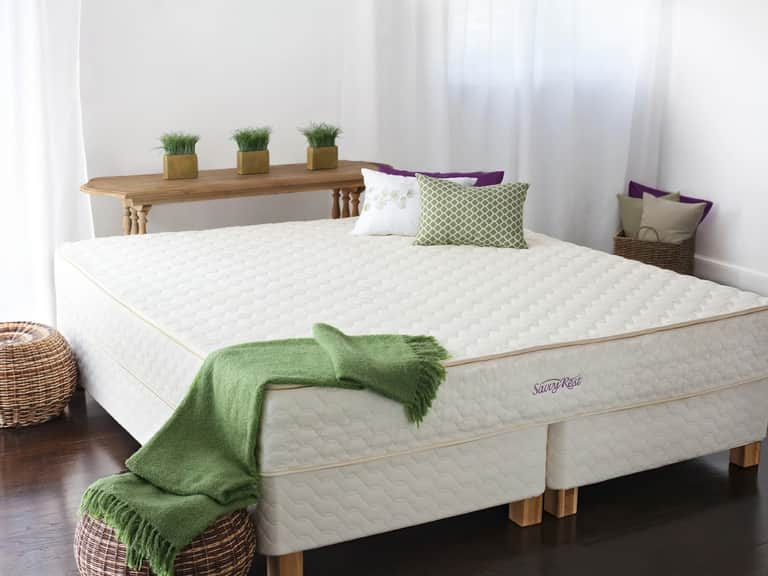
For example, the Savvy Rest Serenity Latex Mattress is a customizable, three-layer latex mattress with soft, medium, and firm layer options. It illustrates how firmness can be configured within a mattress rather than added only as a separate surface layer. Its product details describe Dunlop and Talalay latex options, an organic cotton casing, and organic wool quilting; the configuration should be considered according to the manufacturer’s specifications and the sleeper’s needs.
This example is not a recommendation for a particular firmness. It simply shows why construction details matter: a “latex bed” may have multiple layers, and the way those layers are arranged can shape the result. Whether choosing a topper or an adjustable layered mattress, examine the composition and the available exchange or return terms.
Frequently asked questions
How thick should a natural latex topper be?
Choose thickness according to how much you want to alter the surface, how supportive the existing mattress remains, and whether additional bed height is practical. A thinner layer often makes a subtler change; a thicker layer usually makes a more pronounced one. Firmness and mattress condition still influence the result.
Will a latex topper make a firm mattress softer?
It can soften the surface impression, particularly when the topper is softer than the mattress beneath it. The change depends on thickness and construction. It cannot fix a mattress that is uneven or has lost its underlying support.
Is soft or firm latex better for side sleepers?
Some side sleepers prefer more cushioning around the shoulders and hips, while others feel better on a firmer surface. Body shape, mattress firmness, and personal comfort all matter. Use sleep position as a guide for testing, not as a rule that determines one correct choice.
Does Dunlop or Talalay latex feel softer?
The manufacturing process can influence the material, but process name alone does not establish how a particular product will feel. Firmness, formulation, thickness, and cover construction also contribute. Compare the manufacturer’s actual product descriptions and, where possible, test samples.
Can a topper be used on any mattress?
Many toppers are intended for common mattress types, but dimensions, foundation requirements, and product guidance vary. Check compatibility with the mattress and base, and make sure the surface is in good condition before adding a layer.
The best fit is the one that solves the right problem
Choosing a natural latex topper is less about finding a universally perfect thickness or firmness than about understanding the bed already in place. A thin layer may preserve most of a mattress’s character; a thicker one can create a more pronounced change. Softer latex yields more readily, while firmer latex tends to offer greater resistance. But these qualities work together, and the mattress beneath remains part of the equation.
Begin with its condition, identify where comfort falls short, and then compare construction, dimensions, and firmness options. Consider sleep position, shared-bed preferences, bedding fit, and care requirements. With those details in view, a topper becomes more than an extra layer: it becomes a deliberate adjustment to the landscape where each night begins.